Catan Trading Strategy: How to Negotiate Like a Pro
Good Catan trading strategy comes down to one principle: trade actively but never strengthen an opponent more than you strengthen yourself. Offer fair deals every turn, use scarcity to your advantage, leverage ports as your walk-away option, and always check the victory point count before handing anyone the card they need. Trading is the most underrated skill in Catan — and the most decisive.

The bank gives you 4:1. Your opponents will give you 2:1 or 1:1 all game long if you ask. That gap is pure profit for whoever masters Catan trading strategy.
Why Catan Trading Strategy Matters More Than You Think
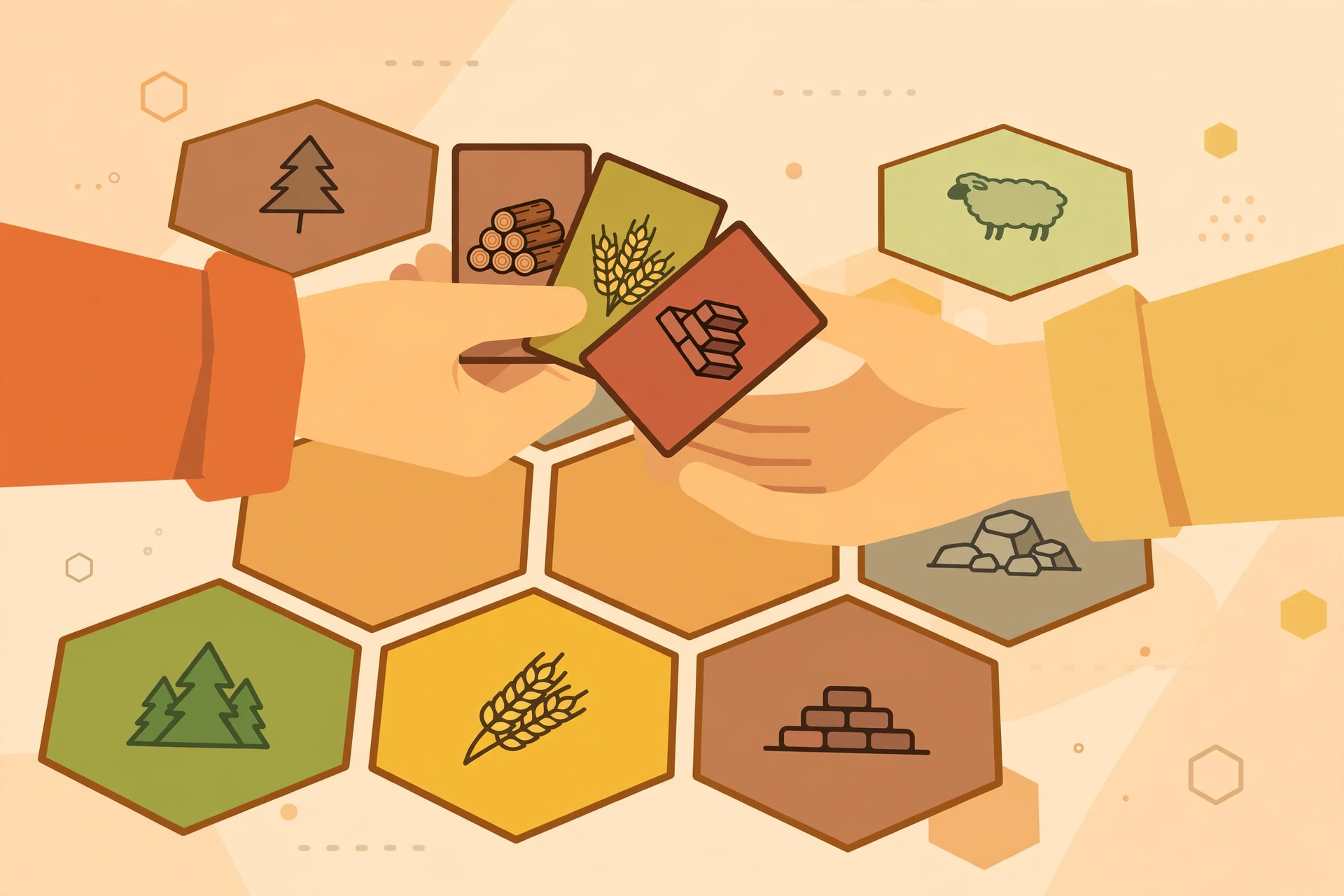
Every trade converts your surplus into your shortage at a better rate than the bank. But the deeper value is tempo: trading turns dead cards in your hand into builds on the board, and builds win games. A player who trades five times per game will almost always beat an equally positioned player who trades once. Beginners treat trading as a fallback (“I’ll trade if I have to”). Strong players treat Catan trading strategy as a primary engine — they shape their whole game around being trade-friendly.
Valuing Resources
Not all resources are equal, and their value shifts by game phase: Early game: lumber and brick are king (roads and settlements). Sheep is valuable (settlements + dev cards). Mid game: ore and grain surge (cities cost 3 ore + 2 grain; dev cards need sheep/grain/ore). Late game: whatever completes your winning build — value becomes entirely situational. Scarcity also matters: if the board is ore-poor, ore trades at a premium all game. Read the board’s economy before proposing deals.
Negotiation Tactics That Work
Always counter. “I’ll give you 2 sheep for 1 ore” → counter “1 sheep for 1 ore?” The first offer is rarely final. Bundle for tempo. Offering 2-for-1 deals that let you build immediately is often correct even at “bad” rates — a settlement now beats perfect efficiency later. Use the table. “Does anyone have brick for sheep?” Open offers create competition among sellers, which improves your price. Trade future promises carefully. “I’ll give you my next ore” deals happen, but they’re unenforceable — keep them small and immediate. Know when to walk away. Your best alternative to a negotiated agreement is the bank or a port. Desperation is visible and expensive.
Ports as Leverage
A settlement on a 3:1 port means you never truly need opponents — you can always convert at 3:1. This changes every negotiation: you’re trading for convenience and tempo, not survival. The 2:1 ports are even stronger. A 2:1 sheep port with sheep-heavy production is basically a resource printer. Use the port quietly rather than announcing every conversion — table politics are real.
Deals to Avoid
Don’t feed the leader. Check victory points before every trade — giving the 8-point player their missing brick for Longest Road is game-losing. Don’t trade into an obvious win. If someone needs one specific card and you can see their path to 10, don’t hand it over. Don’t accept every offer. Some trades help opponents more than you — evaluate what each side builds. Don’t hold grudges. The player who robbed you three turns ago offering a fair trade now is still a fair trade — punishing them costs you tempo. (See also: common Catan mistakes.)
Frequently Asked Questions
What is good Catan trading strategy? Trade often, trade fairly, and never strengthen an opponent more than yourself. Offer deals every turn, use the table for competition, and always check victory points before accepting.
What’s a fair trade in Catan? 1:1 between different resources is the baseline. 2:1 either way is common when one side is desperate or one resource is scarce.
Should I trade with the winning player? Usually no, unless the trade helps you more — like completing your own game-winning build. Starve the leader, feed the trailers (slightly).
How do I get people to trade with me? Offer first, offer often, and be pleasant. Players trade with people they like. Keep your needs visible.
Are table-talk deals binding? By official rules, only the immediate card exchange is binding. Future promises are handshake deals — keep them small.
When should I use the bank instead of trading? When opponents’ prices are worse than bank rates, when you don’t want to strengthen anyone, or when you need to convert quietly. For the game’s background, see Catan on Wikipedia.
Master Catan trading strategy and you’ll convert more surpluses into wins than any other single skill.
Catan is a trademark of Catan GmbH. This is an unofficial fan guide.