
Catan Dice Probability Explained: Number Tokens & Pip Values
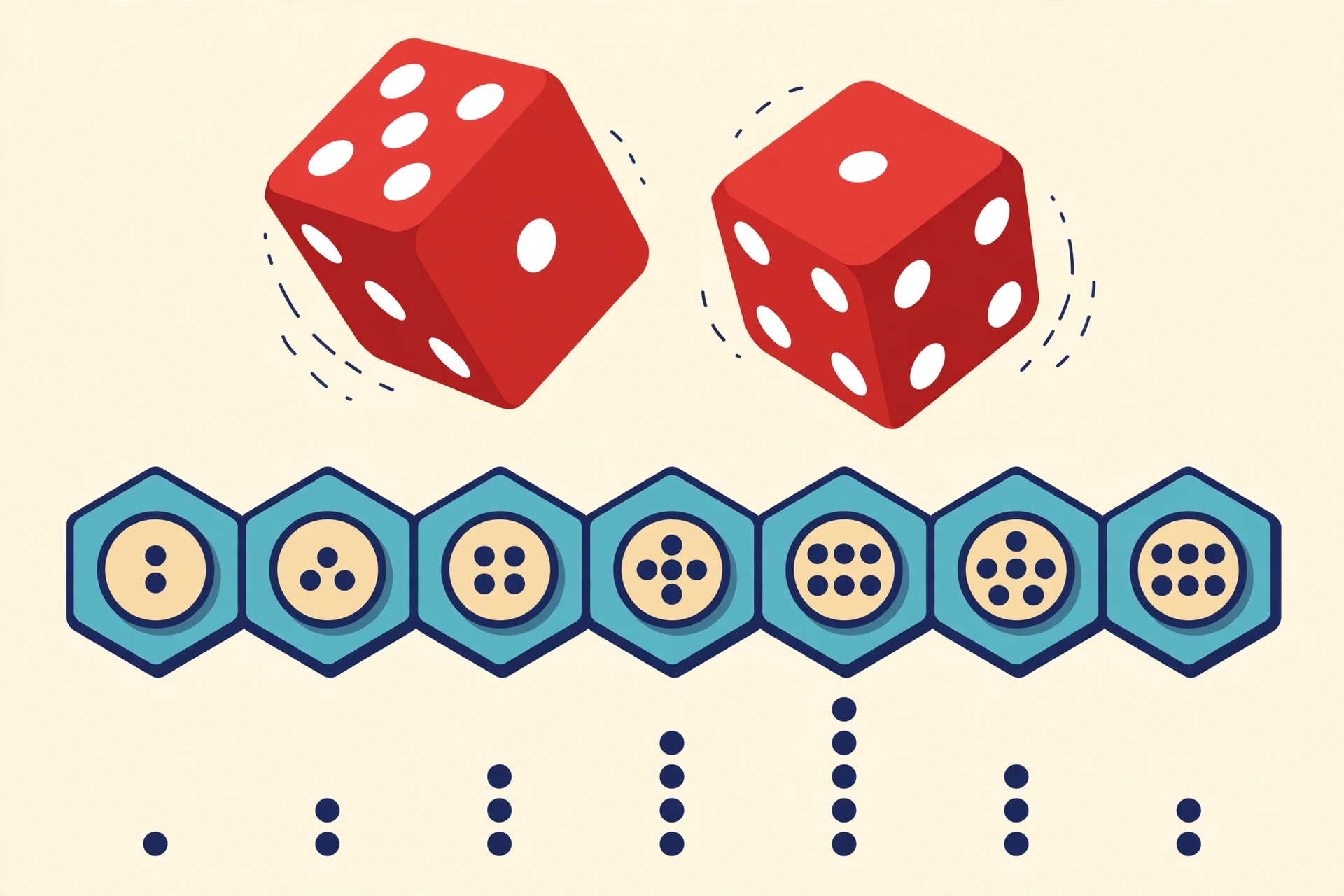
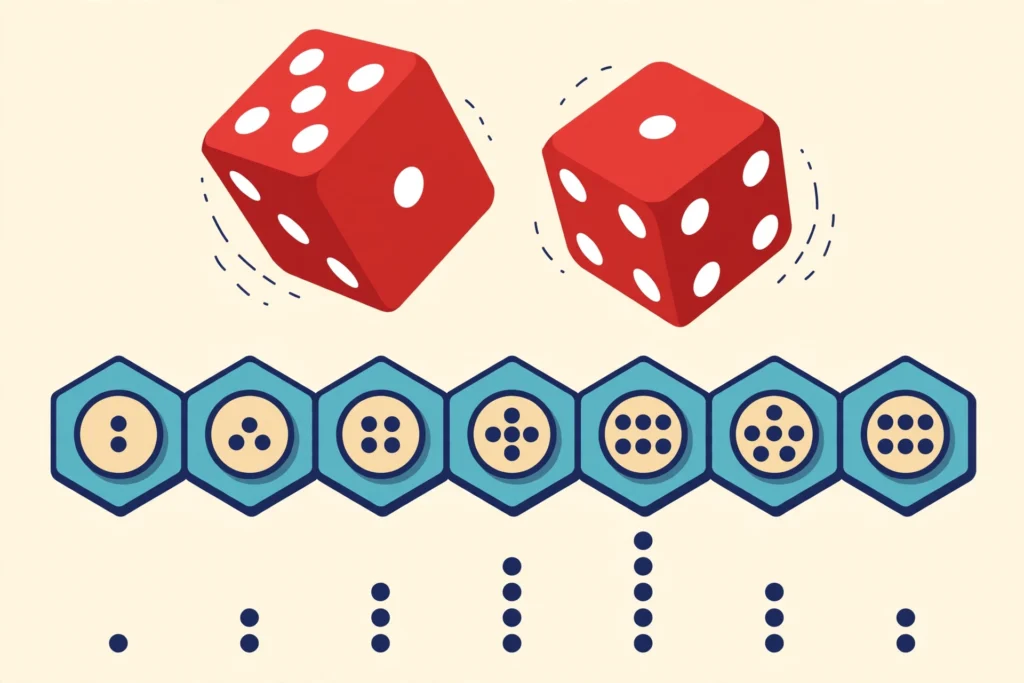
Catan dice probability is simple: with two six-sided dice there are 36 possible outcomes, and 7 is the most common roll (6 out of 36), followed by 6 and 8 (5 each). The dots — called pips — printed under each number token tell you its probability at a glance: more pips means more expected resources. Understanding this single concept transforms how you evaluate every settlement spot on the board.
Understanding Catan dice probability is the foundation of good Catan strategy. Let’s break it down properly.
Catan Dice Probability: The Full Table
When you roll two dice, the number of combinations producing each total is:
| Total | Combinations | Probability |
|---|---|---|
| 2 | 1 | 2.8% |
| 3 | 2 | 5.6% |
| 4 | 3 | 8.3% |
| 5 | 4 | 11.1% |
| 6 | 5 | 13.9% |
| 7 | 6 | 16.7% |
| 8 | 5 | 13.9% |
| 9 | 4 | 11.1% |
| 10 | 3 | 8.3% |
| 11 | 2 | 5.6% |
| 12 | 1 | 2.8% |
The game marks 6 and 8 in red because they’re the highest-probability production numbers. The 7 — most common of all — produces nothing and instead activates the robber, the game’s built-in catch-up and disruption mechanic.
Reading Pip Values
Each number token shows small dots beneath the number. A 6 shows five dots, a 9 shows four, a 4 shows three, and so on. These pips are a visual shortcut for the table above. When evaluating a settlement intersection, add up the pips of the adjacent hexes. An intersection touching 6-9-4 has 5+4+3 = 12 pips. One touching 2-11-12 has 1+2+1 = 4 pips. The first spot will produce roughly three times the resources over a game. This pip-counting habit is the fastest skill upgrade a new player can make.
Expected Production Per Roll
This is Catan dice probability in action: each pip represents roughly one resource card per 36 rolls (one full “cycle” of probability). A 12-pip start should yield about 12 cards per 36 rolls — roughly one card every three rolls. A 4-pip start yields about 4 cards per 36 rolls — one every nine rolls. Over a typical 60-80 roll game, that difference compounds enormously. The 12-pip player sees maybe 20+ cards from their start; the 4-pip player sees 7 or 8. That’s the game, right there.
Why the 7 Matters So Much
At 16.7%, the 7 is the single most likely outcome — and it produces nothing. Instead, the roller moves the robber, steals a card, and everyone holding 8+ cards discards half. This does three things strategically: 1. It taxes big hands. Holding 8+ cards is risky — spend down aggressively before the 7 hits. 2. It punishes leaders. The robber goes on the leader’s best hex. 3. It creates tempo. A 7 at the wrong moment can stall your entire plan — which is why flexible, diversified positions beat brittle ones.
Probability in Practice: Three Rules
Rule 1: Never trust a 2 or 12. One pip means one expected card per 36 rolls. Treat 2/12 hexes as nearly blank unless everything else about the spot is perfect. Rule 2: The 6-8 split is sacred. Official setup rules keep 6s and 8s apart for good reason — adjacent red numbers warp the game around one region. Rule 3: Variance is real. Probability describes the long run. In any single game, the dice can betray the math — play the odds, accept the noise.
Frequently Asked Questions
What do the dots under Catan numbers mean? They’re probability pips — each dot represents one of the 36 dice combinations that produces that number. More dots = more likely to roll = more expected resources.
Why are 6 and 8 red? They’re the highest-probability production numbers (5 combinations each, ~14% per roll). Setup rules keep them separated so no region dominates.
How often does each number roll in a typical game? In a 72-roll game, expect roughly: 6/8 about 10 times each, 5/9 about 8 times each, 4/10 about 6 times each, 3/11 about 4 times each, 2/12 about 2 times each, and 7 about 12 times.
Should I avoid settling on 2 and 12? Mostly yes. Only consider them as a third hex on an otherwise excellent intersection — never as the reason to take a spot.
How does Catan dice probability affect starting placement? It decides everything — always place settlements on high-pip intersections covering different resources. See our best starting placements guide to apply this.
Does the robber change the math? Effectively, yes. Because 7s (16.7% of rolls) produce nothing and can block your hexes, real expected production is a bit lower than raw pip math — and concentrated positions suffer more than diversified ones.
Once you internalize Catan dice probability, you’ll never evaluate a board the same way again. For the game’s background, see Catan on Wikipedia.
Catan is a trademark of Catan GmbH. This is an unofficial fan guide.